Potassium regulates blood pressure, heart function, muscle contraction, and weight regulation. The average American consumes about half the recommended amount, while consuming more sodium than recommended. The gap has measurable consequences.
The recommended daily intake is 4,700 mg for adults. The average American consumes about 2,600 mg. Meanwhile, average sodium intake is 3,400 mg — well above the recommended limit of 2,300 mg. This inverted ratio has consequences across multiple organ systems.
Data from NHANES (CDC) and NIH surveys. Potassium intake fell as processed food consumption increased; obesity and depression diagnoses rose in parallel. Multiple research groups have called for clinical trials to test the causal relationship.
Sources: Potassium intake from NHANES surveys (CDC). Obesity prevalence from CDC NHES/NHANES. Depression/anxiety prevalence from NIH — National Survey on Drug Use and Health.
The effect sizes below come from randomized controlled trials and meta-analyses — replicated findings across multiple research groups and populations.
Pooled result from 22 RCTs (n=1,606, WHO meta-analysis): increasing potassium intake lowers systolic BP ~6 mmHg and diastolic ~4 mmHg. Effect is larger in people with hypertension and those on high-sodium diets. A 5 mmHg population-level reduction in systolic BP would prevent an estimated ~100,000 cardiovascular deaths per year in the US alone.1
The Salt Substitute and Stroke Study (SSaSS, NEJM 2021) — a cluster-randomized trial of 20,995 adults — is the largest K intervention trial ever conducted. Participants used potassium-enriched salt (~25% KCl) for 5 years. Results: 14% fewer strokes, 13% fewer major cardiovascular events, 12% lower all-cause mortality. No increase in hyperkalemia or serious adverse events.2
Separate meta-analysis: each 1,000 mg increase in daily K intake reduces stroke risk by ~11%.3
A 2019 controlled trial in Nutrients found increased dietary potassium was a stronger predictor of weight loss than reductions in sugar or total calories. Participants who increased K intake by 25% lost 11% of body weight; those who increased it by 3% lost 8% (p=0.033).4 A 2023 Frontiers in Nutrition study found higher K intake was associated with lower body fat percentage independent of total calorie intake, fiber consumption, and physical activity level.5 The mechanism: potassium is a required cofactor for glycogen storage — dietary carbohydrates cannot be stored in muscle tissue without adequate potassium.
Potassium citrate has been the standard medical therapy for calcium kidney stones for 30+ years. It works by increasing urinary citrate, which binds calcium and prevents crystallization. Multiple randomized trials show potassium citrate reduces stone recurrence by 40–70%.6 The DASH diet — high in potassium from fruits, vegetables, and legumes — is associated with ~50% lower kidney stone incidence. About 10% of adults will experience a kidney stone in their lifetime.
A 2023 study in Brain and Behavior using 24-hour urinary potassium (gold standard) found adults with the lowest K intake had 2.7× higher odds of depression and 2.1× higher odds of anxiety vs the highest intake group, independent of age, sex, and BMI.14 A 2025 case report in J Med Case Reports documented rapid resolution of severe depression following K supplementation, sustained over three years.15 A 2024 JAMA Network Open RCT found a KV7 potassium channel opener produced antidepressant effects, confirming K+ channels directly regulate mood by controlling neurotransmitter release and neuronal excitability.
Potassium is required for insulin secretion from pancreatic beta cells. The Nurses' Health Study found higher dietary K associated with lower risk of type 2 diabetes. Low serum K → 64% higher diabetes risk in hypertensive patients on diuretics.10 K is co-transported with glucose into cells — when you eat carbohydrates, you need potassium for storage.
Potassium citrate reduces the body's acid load, decreasing bone resorption and calcium loss in urine. A 2024 meta-analysis found DASH diet adherence (high K, high produce, low acid) associated with 22% lower osteoporosis risk and ~10% lower fracture risk, independent of calcium intake.9 Potassium citrate treatment for 24 months significantly increased lumbar spine bone mineral density in healthy elderly adults. The thiazide-NCC connection amplifies this — NCC activation increases calcium reabsorption, and K-citrate boosts urinary citrate, which binds calcium and prevents crystallization.
Potassium is the primary intracellular cation in muscle tissue and is required for glycogen storage, muscle contraction, and nerve signaling. Intense exercise depletes muscle K⁺ stores — a single hour of heavy sweating can lose 1,000–2,000 mg of potassium. Higher dietary K intake is associated with better muscle mass, grip strength, and physical performance in adults across all ages.11 Potassium also accelerates post-exercise glycogen resynthesis when consumed with carbohydrates, since K⁺ is co-transported with glucose into muscle cells.
A 2026 review in Nature Reviews Nephrology consolidated the evidence for the K⁺ switch — a signaling pathway in the kidney's distal convoluted tubule that directly couples potassium sensing to sodium handling.7 Three components: Kir4.1/Kir5.1 potassium channels that detect extracellular potassium, a WNK kinase phosphorylation cascade, and the thiazide-sensitive sodium-chloride cotransporter (NCC) — the same target used by thiazide diuretics for hypertension.
Low dietary potassium → switch activates → NCC turns on → kidneys reabsorb sodium.
Adequate potassium → switch is inhibited → NCC turns off → sodium is excreted.
This system evolved for ancestral high-potassium diets. In the modern low-potassium environment, it remains chronically activated, directly contributing to salt-sensitive hypertension.
NCC (the thiazide-sensitive sodium-chloride cotransporter) is a protein in the kidney's distal convoluted tubule that reabsorbs sodium and chloride from the filtrate back into the blood. It is the final checkpoint for sodium handling before it reaches the urine. When NCC is active, sodium stays in the body and water follows it, expanding blood volume and raising blood pressure.
This is the same molecular target that thiazide diuretics — some of the most prescribed blood pressure medications — are designed to block. The K⁺ switch effectively activates or inhibits this target based on potassium status. When dietary potassium is low, the kidney activates NCC, driving salt-sensitive hypertension. When potassium is adequate, NCC is turned off, and excess sodium is excreted.
The downstream effects of NCC go beyond a simple sodium/potassium seesaw. The cascade is intricate — here's what happens when NCC turns ON:
While the K⁺ switch at the distal convoluted tubule controls NCC activity, the kidney has a second potassium-handling system in the collecting duct that determines how much K⁺ ultimately ends up in the urine. This system revolves around two channels working in concert: ROMK (Kir1.1, the renal outer medullary potassium channel) and ENaC (the epithelial sodium channel).
ROMK is the primary K⁺ secretion channel in the collecting duct. It sits on the apical membrane and allows K⁺ to flow from the cell into the tubular fluid. ENaC reabsorbs Na⁺ from the filtrate into the cell — and this is the key: Na⁺ reabsorption through ENaC creates a lumen-negative electrical potential. This negative charge pulls positively charged K⁺ through ROMK and into the urine.
This partnership is dynamically regulated by potassium status:
Aldosterone — the body's main salt-retaining hormone — powerfully stimulates both ENaC and ROMK. This is why aldosterone-driven states (hyperaldosteronism, Conn's syndrome) cause both sodium retention and potassium wasting. Thiazide diuretics exploit a related mechanism: by inhibiting NCC, they deliver more Na⁺ to the collecting duct, where it gets reabsorbed by ENaC, creating a stronger electrical gradient for K⁺ secretion. This is the thiazide paradox — NCC inhibitors lower blood pressure but can cause hypokalemia (low K⁺) precisely because they shunt sodium downstream to the ENaC/ROMK pathway.
Potassium doesn't just regulate kidney function — it directly modulates electrical activity in every excitable tissue in the body. The same K⁺ that passes through the kidney's NCC switch also controls insulin release, blood vessel tone, neuronal firing, and heart rhythm through specialized potassium channels throughout the body. Here are the four most consequential extra-renal K⁺ sensing pathways:
Pancreatic beta cells couple blood glucose to insulin release via ATP-sensitive potassium channels (KATP, composed of Kir6.2 and SUR1 subunits). When extracellular K⁺ is low, the beta cell membrane hyperpolarizes (becomes more negative), making it harder for glucose to trigger insulin secretion. This is why hypokalemia impairs glucose tolerance — the beta cells can't depolarize enough to release insulin. Low K⁺ → hyperpolarized beta cell → less insulin → higher blood sugar. Correcting the K⁺ deficit restores normal insulin secretion.
Blood vessels themselves sense potassium directly. When dietary K⁺ rises and blood K⁺ increases even slightly, vascular endothelial cells detect it through inward-rectifier K⁺ channels (Kir2.1) and calcium-activated K⁺ channels (SK and IK). This K⁺ influx hyperpolarizes the endothelial cell, which opens voltage-sensitive calcium channels. The resulting calcium spike triggers nitric oxide (NO) release, causing the underlying smooth muscle to relax. The artery dilates, blood pressure drops — an effect that is entirely independent of the kidney. This direct vasodilatory pathway (K⁺ → endothelial hyperpolarization → NO → vasodilation → ⬇ BP) accounted for a significant portion of the BP reduction seen with high-potassium diets in the DASH-sodium trial.
In the brain, neuronal excitability is tightly controlled by voltage-gated potassium channels, particularly Kv7 (KCNQ/M-channel) complexes. These channels are the molecular target of the drug ezogabine (retigabine), which was shown in a 2024 JAMA Network Open RCT to produce clinically significant antidepressant effects within one week. The mechanism: Kv7 channels regulate the resting membrane potential and control neurotransmitter release. When K⁺ is deficient, these channels become less effective, leading to neuronal hyperexcitability — linked to anxiety, depression, and seizure susceptibility. Potassium deficiency → impaired Kv7 function → neuronal hyperexcitability → mood dysregulation — a direct causal pathway between diet and brain function.
The heart's electrical stability depends on several K⁺ channel families: Kir2.x channels maintain the resting membrane potential of cardiomyocytes, while Kv (voltage-gated) channels control repolarization after each heartbeat. Hypokalemia (low K⁺) has three direct cardiac consequences: (1) Kir2.x channels conduct less current, making the resting potential less stable; (2) Kv channels repolarize more slowly, prolonging the QT interval; (3) the risk of arrhythmia — particularly Torsades de Pointes — rises sharply. The ECG changes of hypokalemia (ST depression, T wave inversion, U waves) reflect these molecular derangements. Even mild potassium depletion (3.0–3.5 mmol/L) significantly increases arrhythmia risk in patients with heart disease.
Paleolithic hunter-gatherers consumed an estimated 11,000 mg of potassium and 700 mg of sodium daily (K:Na ratio ~15:1). The modern American diet produces the inverse: 2,600 mg potassium and 3,400 mg sodium (ratio ~1:1.3). Our kidneys evolved over 2+ million years in a high-potassium, low-sodium environment — they haven't adapted to the industrialized food environment of the last century.
Potassium stimulates endothelial nitric oxide production, directly relaxing blood vessel walls and reducing peripheral resistance.
Pancreatic beta cells release insulin through ATP-sensitive potassium channels. Low extracellular K⁺ impairs this process, reducing glucose tolerance.
K⁺ is co-transported with glucose into muscle and liver cells. Inadequate potassium limits glycogen replenishment after carbohydrate consumption.
Potassium citrate buffers dietary acid, reducing bone resorption. K-citrate treatment for 24 months significantly increased bone mineral density in healthy elderly.9
Most useful metric: milligrams of potassium per calorie. Leafy greens dominate by a wide margin.
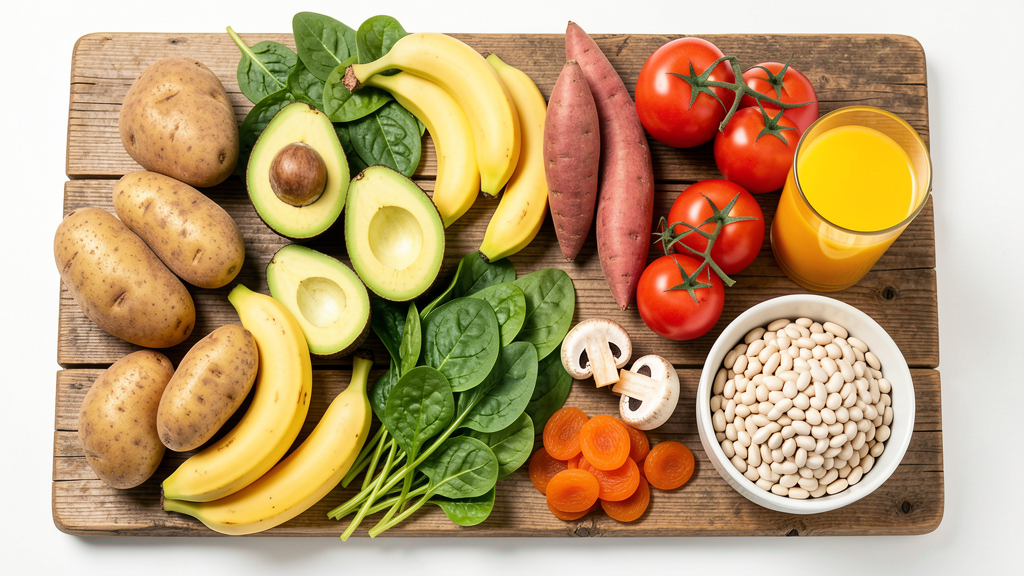
Potatoes, beans, and tomato paste deliver potassium for pennies.
The takeaway: A medium baked potato with the skin delivers 925 mg of potassium — 20% of your daily target — for roughly 32 cents. A Purdue RCT proved that potassium from potatoes has identical bioavailability to supplements (>94% absorption).11 A cup of cooked spinach gives you more potassium than a banana for barely any calories. If you only eat three high-K foods, make them: potatoes, spinach, and white beans.
Common grocery foods — no supplements, no special ingredients.
Total potassium — 24% above the 4,700 mg daily target
Estimated grocery cost for the day
Going higher: For 6,000–7,000 mg/day, add coconut water (+600 mg/cup), a second potato at dinner, or more dried apricots. There is no upper intake limit for food-source potassium in healthy people.
These studies convinced the WHO, the AHA, and a growing number of cardiologists that potassium is one of the most underused tools in preventive medicine.
Participants replaced table salt with a K-enriched version (25% KCl). K intake rose 57%; Na dropped 13%.
Daily K intake inversely associated with all-cause mortality. Inflection point: 3,501 mg/day. Na:K ratio inflection point: 1.203 mg/mg — above which risk rose significantly.
Higher K intake independently associated with lower BP. In 4 remote populations with high-K, low-Na diets, hypertension was virtually absent and BP did not rise with age.
Increased K intake was a stronger predictor of weight loss than cutting sugar or calories. Higher K group lost 11% body weight vs. 8% (p=0.018).
Also: K inversely associated with body fat independent of calories (Front. Nutr. 2023); K-citrate increases BMD (JCEM 2013); K deficiency impairs insulin secretion (JAMA 2010); K⁺ switch mechanism (Nature Rev. Nephrol. 2026).
For people with normal kidney function, there is no established upper limit for potassium from food sources. The Institute of Medicine declined to set a Tolerable Upper Intake Level because there is no evidence of harm from dietary potassium. Healthy kidneys can excrete up to ~400 mmol (15,600 mg) per day — far more than anyone would consume through food. Hyperkalemia from food alone is extremely rare in healthy individuals.
The danger is with potassium supplements, not food. The FDA limits single supplement doses to 99 mg because higher amounts can cause gastrointestinal lesions. If you have chronic kidney disease (CKD stage 3–5) or take medications that raise potassium (ACE inhibitors, ARBs, potassium-sparing diuretics), consult a physician before making dietary changes.
Yes. The meal plan above shows how: breakfast of orange juice, banana, and spinach provides ~1,200 mg. Lunch of baked potato and white beans provides ~1,700 mg. Dinner of salmon, sweet potato, spinach, and mushrooms provides ~2,000 mg. Snacks add another ~800 mg. Total: ~5,800 mg. It requires intention — you won't hit these numbers on a processed food diet — but the foods are all commonly available and affordable.
Boiling leaches potassium into the cooking water. Baking, roasting, and steaming retain it well. The skin of potatoes and sweet potatoes is particularly rich — eat it. Frozen vegetables have comparable potassium content to fresh.
Yes. Sweat losses can reach 1,000–2,000 mg of potassium during heavy training. Potassium is also a required cofactor for glycogen storage in muscle. Active individuals may benefit from 5,000–7,000 mg/day from food. Coconut water and potatoes are effective post-exercise sources.
The Slime Mold Time Mold writeup of Krinn's self-experiment documented significant weight loss, reduced appetite, and improved energy after consuming high doses of potassium.13 The proposed mechanism — intracellular potassium affecting adipocyte metabolism — is biologically plausible and consistent with trial data. However, this remains a hypothesis that requires further research. The available evidence shows a consistent association between higher potassium intake and lower body weight.